

CAUTIONSpoilers ahead. This post includes solution details (and flags).
I picked three challenges that felt very “classic CTF”: one format-string chain, one glibc heap chain, and one retro DOS reverse.
[Pwn] igetsit
| Item | Value |
|---|---|
| Bug | gets() overflow + format string sink |
| Win condition | Turn printf(fmt, ...) into system(fmt) |
What I noticed
The program keeps 8 global “bins” (bin0..bin7) where the size doubles each index. The interesting detail is placement: a global format buffer lives right after the biggest bin (bin7) in .data.
That means:
- if I can overflow
bin7, I can overwrite the format string - if the program ever does
printf(format, something), I get a format-string primitive
Bug 1: gets() plus a fake length check
The write path uses gets(binX) and then tries to “validate” with strlen(binX).
The check is bypassable because gets() writes bytes first, but strlen() only cares where the first \0 is.
So I sent input that starts with a null byte:
\x00AAAA....(lots of bytes)strlen() returns 0, the check passes, and the overflow still happens.
Bug 2: format string sink on an invalid menu choice
The read path asks how to print a value (int/float/string/pointer). If I give an invalid option, it prints an error but still executes something like:
printf(readFormat, value);Once readFormat is under my control, this becomes:
- leaks:
%p,%s - writes:
%hn,%hhn
Exploit chain (high level)
- Overflow
bin7to overwritereadFormat. - Leak PIE with a stack pointer leak (I used
%10$p) and compute the binary base. - Read
printf@GOTwith%1$sby placing the target address in a bin. - Compute libc base and
system. - Partially overwrite
printf@GOTto point tosystem(a small 2-byte patch). - Set
readFormattocat flagand trigger the invalid read option.
WARNINGThe reason partial GOT overwrite is nice here: the program calls
printfa lot, so a full 8-byte rewrite is noisy. Changing only the middle bytes was enough for this libc.
Concept map
flowchart TD A["Find globals: bin7 next to format buffer"] --> B["Overflow bin7 via gets"] B --> C["Bypass length check with leading NUL"] C --> D["Control format buffer"] D --> E["Invalid read path calls printf with attacker format"]
E --> F["Leak PIE base (pointer leak)"] F --> G["Compute PIE base"] G --> H["Locate printf GOT"]
E --> I["Read memory from a chosen pointer"] I --> J["Leak runtime printf address"] J --> K["Compute libc base and system"]
E --> L["Write short value to a chosen pointer"] L --> M["Patch printf GOT to system (partial overwrite)"] M --> N["Set format buffer to 'cat flag'"] N --> O["Trigger system('cat flag')"] O --> P["Flag"]Flag
bkctf{g0_g3ts()_y0ur_bag_gIr1}
[Pwn] Dogtrack
| Item | Value |
|---|---|
| Libc | glibc 2.27 (tcache) |
| Core bugs | off-by-null + hidden swap primitive |
| Final | tcache poison -> __free_hook = system |
Why I went for heap
The binary is hardened enough that “just ret2win” is not the path (PIE/NX/canary/RELRO). But it allocates and frees objects all the time, and a few tiny mistakes give heap primitives.
The two key primitives
- A one-byte out-of-bounds null write after a dog chunk.
That lets you clear the prev_inuse bit of the next chunk and set up backward consolidation.
- A hidden Hall of Fame option (menu option 4) that swaps records using
strcpy.
Once you can make a record pointer dangle/overlap freed memory, a sloppy string-copy swap is a great way to stomp heap metadata.
Exploit chain (high level)
- Get a heap leak by abusing a record printer that treats chunk bytes as a C-string.
- Use off-by-null to prepare a fake chunk and trigger backward consolidation.
- Use the overlap to leak libc from unsorted-bin pointers.
- Poison a tcache
nextpointer using the hidden swap feature. - Allocate onto
__free_hook - 8, writesysteminto__free_hook. - Free a chunk whose bytes start with
/bin/sh.
Concept map
flowchart TD A["Heap-heavy program + modern hardening"] --> B["Look for heap primitives"] B --> C["Dog chunk has 1-byte OOB null write"] B --> D["Hidden option 4: strcpy-based swap"] B --> E["Records printed as C-string leak bytes"]
E --> F["Heap leak"] C --> G["Clear prev_inuse / set up fake chunk"] F --> H["Compute target chunk locations"] G --> I["Trigger backward consolidation"] I --> J["Create overlap / dangling record pointer"] J --> K["Unsorted-bin libc leak"] K --> L["Compute __free_hook + system"]
D --> M["Tcache poisoning via swap"] M --> N["Allocate at __free_hook-8"] N --> O["Write __free_hook = system"] O --> P["Free chunk starting with /bin/sh"] P --> Q["Shell and read flag"]Flag
bkctf{7h3_r4w35t_0f_h07d0G5}
[Rev] IMGGEN81
| Item | Value |
|---|---|
| Artifact | IMGGEN81.EXE (16-bit DOS) |
| Idea | recover hidden prompt prefix, then decrypt a raw 320x200 framebuffer |
| Output | a decrypted image that contains the missing flag suffix |
The shape of the solution
This one is basically two stages:
- Prompt -> “prompt ID” encoder (custom base-36 + shuffle + per-byte transform)
- Framebuffer decrypt (DJB2-ish state -> 8-byte keystream)
Once I reversed the encoder, I could invert it to recover a real prompt prefix that already looks like a flag.
Then I used that prompt to generate the keystream and XOR-decrypt flag.raw.
Stage 1: invert the prompt ID
The binary prints a long “Flag prompt ID” string.
I found its alphabet:
0123456789aBcDeFgHIjkLmNoPQRsTuVwXyZIt packs bytes into 16-bit chunks and emits 4 base-36 digits per chunk (little-endian digit order), then maps each digit through the alphabet.
Before packing, it also does:
- a per-byte transform (
xorwith a weekday-derived byte, then add a derived offset) - an odd/even shuffle
Inverting those steps gave me a stable prompt prefix:
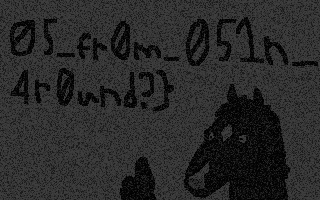
bkctf{h3yy_4r3nt_y0u_7h3_Stage 2: decrypt the 320x200 image
The decrypt stage updates a 64-bit state with:
state = state * 33 + byteThen it turns state into an 8-byte key (key8), and decrypts the raw framebuffer like:
dec[i] = raw[i] xor key8[i%8] xor prompt[i%len(prompt)]After rendering the decrypted bytes as a 320x200 image, the rest of the flag is visible as stylized text.
Concept map
flowchart TD A["Static triage: strings + 16-bit disasm"] --> B["Find printed Flag prompt ID"] B --> C["Decode custom base-36 alphabet"] C --> D["Undo odd/even shuffle"] D --> E["Invert per-byte transform (weekday + error-code path)"] E --> F["Recover prompt prefix: bkctf{...}"]
F --> G["Build state: state = state*33 + ch"] G --> H["Derive 8-byte key8 from state"] H --> I["Decrypt raw: raw xor key8 xor prompt"] I --> J["Render 320x200 framebuffer"] J --> K["Read suffix from image"] K --> L["Full flag"]Flag
bkctf{h3yy_4r3nt_y0u_7h3_05_fr0m_051h_4r0und?}